This page is a translation of the Italian version, which remains the reference text. The service is installed in Italy, in Lazio and Emilia-Romagna. Read the Italian original
Water purifier or filter jug?
A filter jug costs little and works straight away; a reverse-osmosis purifier costs a great deal more and has to be installed. But they do two different things, and the difference is not «more or less filtration»: it is a different mechanism altogether.
Below is what each one does, what they really cost a year (the jug is a surprise), and the cases where a jug is enough and spending more makes no sense.
Try it free for 30 days €29,90 a month if you stay. Nothing up front, no penalty.
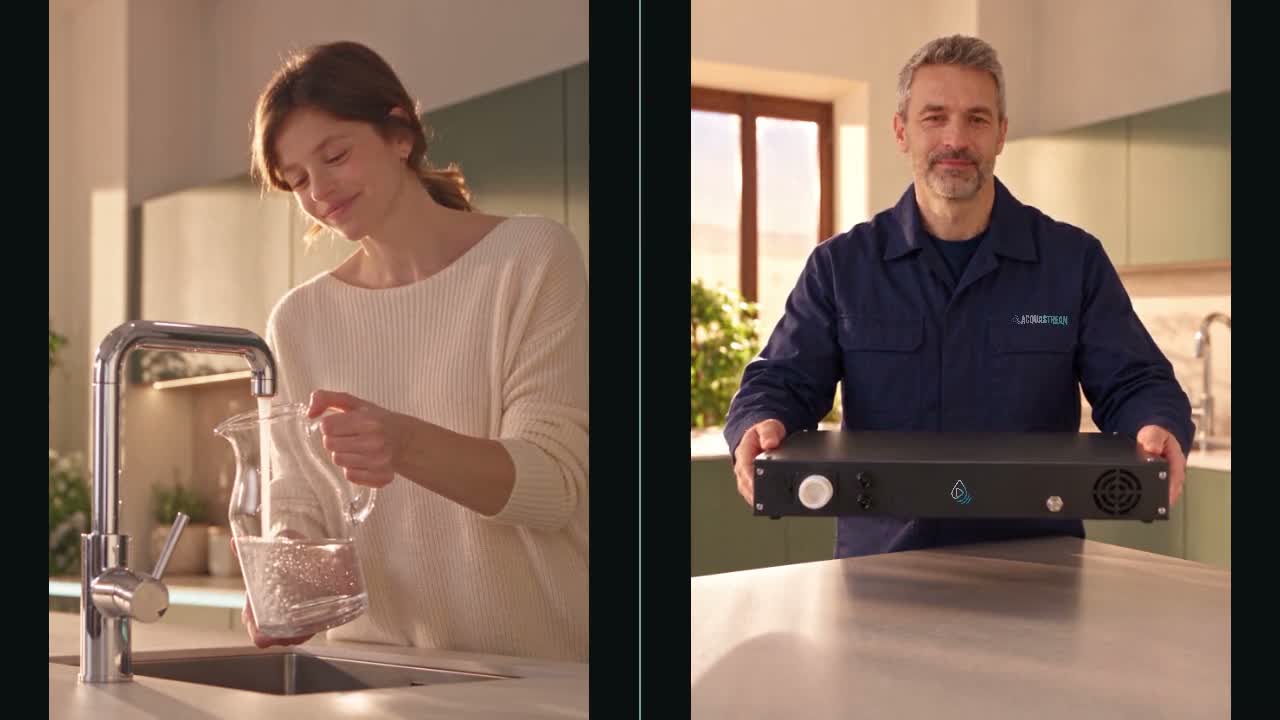
What a filter jug does
A filter jug lets water pass by gravity through a cartridge of activated carbon and ion-exchange resins. The carbon holds back chlorine and some organic substances — what gives taste and smell; the resins hold back part of the calcium and magnesium, so they soften.
What a jug does not do is significantly reduce the overall dry residue: the water comes out nicer to drink, not substantially different in composition.
There is also a hygiene point worth stating: an exhausted cartridge, or a jug left full in a warm room, is an environment where bacteria multiply. The instructions say to change the cartridge roughly every 4 weeks and to keep the jug in the fridge, and those are not token instructions.

What reverse osmosis does
A reverse-osmosis system pushes water against a semi-permeable membrane that holds back most of the dissolved salts. The water that passes through is very low in minerals and for that reason is remineralised immediately afterwards, with calcium, magnesium and potassium.
The result is water with a far lower dry residue than it started with and a steady composition that does not depend on this month's cartridge. In exchange it needs a connection, a socket, space under the sink and scheduled servicing.
What they cost a year
Here the jug loses its apparent advantage. The cost is not the jug: it is the cartridges.
| Filter jug | Osmosis on subscription | |
|---|---|---|
| Up front | €20 – 40 | €0 |
| Refills or fee | €60 – 120 a year in cartridges | €29.90 a month |
| First year | ≈ €80 – 160 | ≈ €478.80 |
| Litres a day | however many you fill by hand | as many as you need |
| Sparkling water | no | yes, with the carbonator |
In pure money the jug costs less, and that should be said. What it does not give is quantity without effort — every litre has to be poured and waited for — and sparkling water. If two of you drink two litres a day, a jug copes; if the household gets through six or seven litres a day between still and sparkling, filling a jug becomes a job.

When a jug is enough
- If you drink little and the only problem is the taste of chlorine.
- If you are renting or about to move: no installation, you take it with you.
- If you want to test whether you like treated tap water, before spending more.
- If you do not drink sparkling water: it is the difference that weighs most in the households where people do.
In all these cases, buying a system means paying for a capacity you will not use.
When a jug is no longer enough
It usually happens for one of three reasons, and almost never because of the quality of the water: because the household drinks too much to keep up with the jugs, because someone wants sparkling water, or because people tire of buying cartridges and remembering when to change them.
If the reason is one of those, the right comparison is not jug against osmosis: it is what a purifier costs against what the bottled water you are already buying costs.
30 days of free water. You only pay if you stay.
We install the system without you paying a single euro up front. If it does not convince you, write to us by day 30: we come and collect it at our own expense, with no penalty.
If you stay, from day 31 it is €29,90 a month plus a one-off €120 installation fee. Cancel whenever you like. The terms
Would you rather talk it through? 347 769 2795.
Request received.
We will call you to check coverage and feasibility. No subscription has been started.
Questions about jugs and purifiers
Does a filter jug change whether the water is drinkable?
Tap water in Italy is already drinkable and tested: a jug does not make it drinkable, it improves the taste by removing chlorine and some organic substances, and it reduces the hardness. It is an improvement in taste, not in drinkability.
How often should the jug cartridge be changed?
Manufacturers' instructions generally say about 4 weeks or a certain number of litres, whichever comes first. Going past that limit is counterproductive: an exhausted cartridge holds back less and can itself become a hygiene problem.
Does a jug lower the dry residue the way osmosis does?
No. The resins in a jug mainly reduce calcium and magnesium, and so the hardness, but not the overall dry residue in the way a reverse-osmosis membrane does.
Can I use jug water in a steam iron?
It reduces limescale compared with mains water, so it helps, but it is not demineralised water. For irons that require it, the appliance's own instructions remain the reference.