This page is a translation of the Italian version, which remains the reference text. The service is installed in Italy, in Lazio and Emilia-Romagna. Read the Italian original
Can you drink the tap water?
Yes. The water coming out of the tap at home in Italy is drinking water, governed by Legislative Decree 18/2023 (which implements European directive 2020/2184) and tested both by the network operator and by the local health authorities (ASL).
This page explains who tests it and how, where to read the figures for your own town without having to take anyone's word for it, and what does — and does not — change when you put in a purifier.
Try it free for 30 days €29,90 a month if you stay. Nothing up front, no penalty.

Who tests it, and how often
There are two sets of checks, and they are independent of each other.
- The network operator (ACEA, Hera, Talete and others, depending on the area) tests the water along the whole route: at the source, in the treatment plants, in the reservoirs and in the distribution network.
- The ASL, the local health authority, carries out external checks with its own samples, and has the power to declare the water unfit to drink.
Dozens of parameters are analysed: microbiological (Escherichia coli, enterococci), chemical (nitrates, arsenic, metals, pesticides, disinfection by-products) and indicators such as hardness, pH and conductivity. If a value goes over the legal limit, the town council issues an order restricting or banning drinking use: it is a public act, not a private message.
Where to read the figures for your own water
You do not have to believe anyone, sites selling purifiers included. The data is public:
- On your operator's website, usually in a «water quality» section where you search by town or by street. It is the most up-to-date source.
- On the bill, where many operators publish the average figures for the year.
- From the town council or the ASL, for orders and external checks.
When you open them, the four figures that say most about everyday life are: hardness (how much limescale there will be), dry residue (how many dissolved salts there are), sodium and nitrates. The others matter, but they either stay within the limit or an order follows.
So why do so many people buy water?
For reasons that have almost nothing to do with whether it is drinkable, and they are worth stating plainly, because this is where the decision is actually made.
- The taste. The chlorine used to keep the water safe along the network can be tasted, and many people do not like it.
- Habit. Italy has been buying bottled water for decades and for many households it is simply what has always been done.
- Sparkling water. It does not come out of the tap, and those who drink it have to buy it.
- Doubt about the pipes in the building, which unlike the public network are nobody's responsibility to test: past the meter, the plumbing belongs to the owner.
What a purifier changes (and what it does not)
This is the part where an honest seller differs from a dishonest one.
It does not change whether the water is drinkable. Mains water is already drinkable: a domestic purifier does not make it so and must not be sold that way. Anyone using coloured test kits or alarms about the network to convince you is doing something the Italian competition authority has already penalised in this sector.
It changes the composition and the taste. A reverse-osmosis system lowers the dry residue considerably, removes the chlorine and with it its taste, and then remineralises. The result is lighter water with a consistent taste.
It changes the convenience. Drinking water, sparkling too, from a tap at home instead of from a crate carried up the stairs. For most people who switch this is the real reason, and there is nothing wrong with saying so.
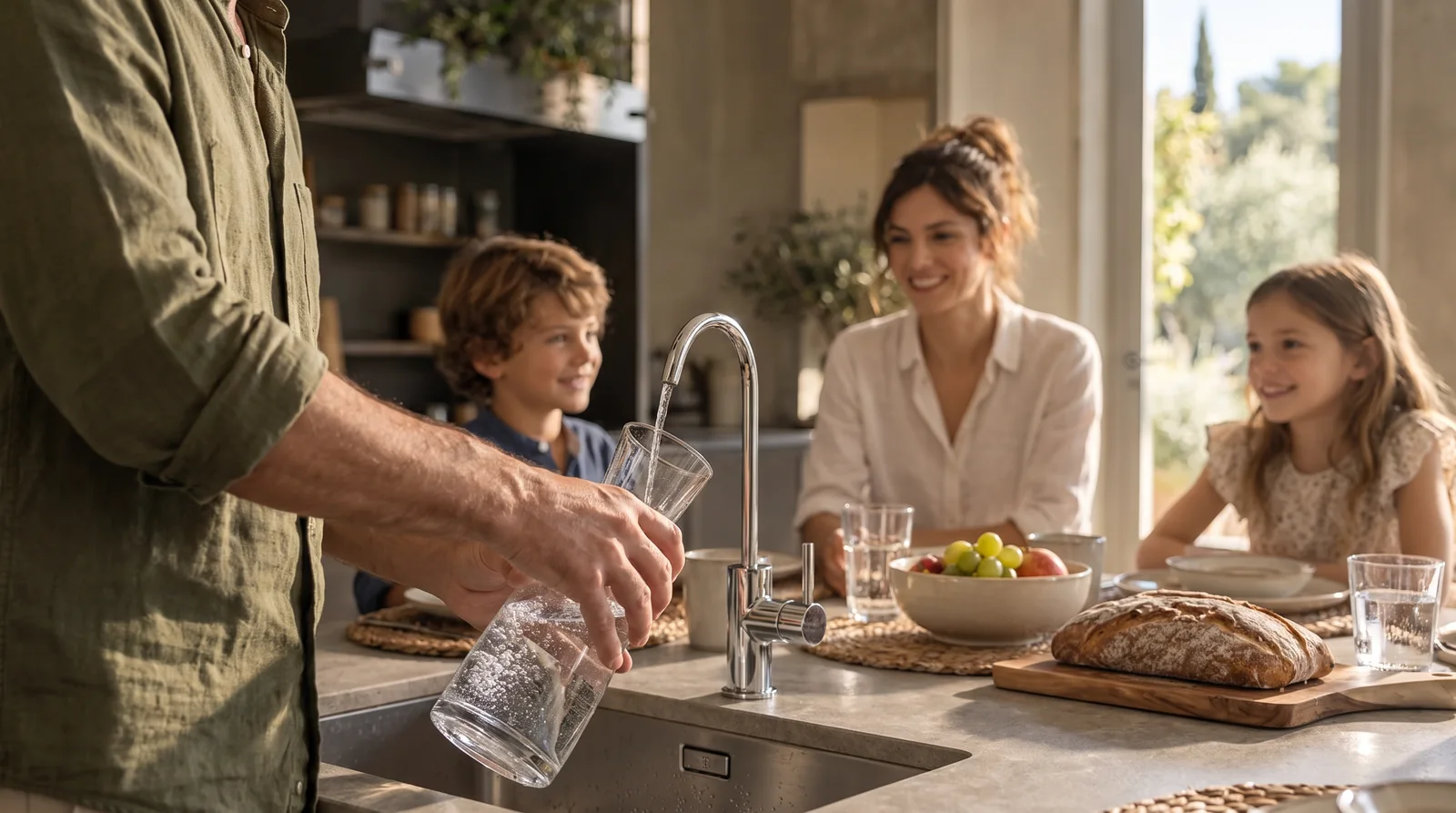
30 days of free water. You only pay if you stay.
We install the system without you paying a single euro up front. If it does not convince you, write to us by day 30: we come and collect it at our own expense, with no penalty.
If you stay, from day 31 it is €29,90 a month plus a one-off €120 installation fee. Cancel whenever you like. The terms
Would you rather talk it through? 347 769 2795.
Request received.
We will call you to check coverage and feasibility. No subscription has been started.
Questions about tap water
Is tap water as safe as bottled water?
Both are regulated by law, under different rules: mains water by Legislative Decree 18/2023, natural mineral waters by their own regime. Mains water is tested far more frequently, because it is sampled all along the distribution network.
How do I find out whether the water in my town is good?
On the network operator's website, in the section on water quality, searching by town or by street; many operators also publish average figures on the bill. For orders, the reference is the town council or the ASL.
Can old pipes in the building spoil the water?
Past the meter the plumbing belongs to the owner and is not covered by the operator's checks. In older buildings it can be worth having the water analysed at the tap rather than relying only on network data, because that data describes the water arriving at the meter.
Should I let the water run before drinking it?
After many hours standing still, as in the morning, letting the water run for a few seconds is a good habit: what was left in the building's pipes has been sitting there. It is common advice in operators' own guidance.